When a dog or a cat flies in the hold — as checked baggage or as cargo — the travel crate becomes part of the animal's safety.
It has to be more than "big enough". What matters is the internal dimensions, the construction, the ventilation, the door, the fastenings, the water container, and above all how the animal can stand, turn around and lie down inside.
These journeys are governed by the IATA Live Animals Regulations.
What IATA is, and why it matters
IATA is the International Air Transport Association. It writes the industry standards for commercial aviation, and live animals have their own set of rules — the Live Animals Regulations. They cover the containers themselves: construction, ventilation, safety and the conditions of carriage.
The current edition has been in force since 1 January 2026, and IATA calls it the global standard for carrying live animals commercially. See IATA on live animals
One thing worth understanding straight away: IATA does not certify particular brands or models of crate. The words "IATA approved" on a shop's website do not by themselves mean the container will be accepted. It has to actually meet the requirements for your animal — and the airline may add conditions of its own. How to select the right container
The main rule: you choose by the animal, not by the weight
One of the commonest mistakes is buying from the manufacturer's table: the dog weighs 25 kg, so size 5.
That is not enough. Two dogs of the same weight can differ a great deal in height, body length, shoulder width and the shape of the head.
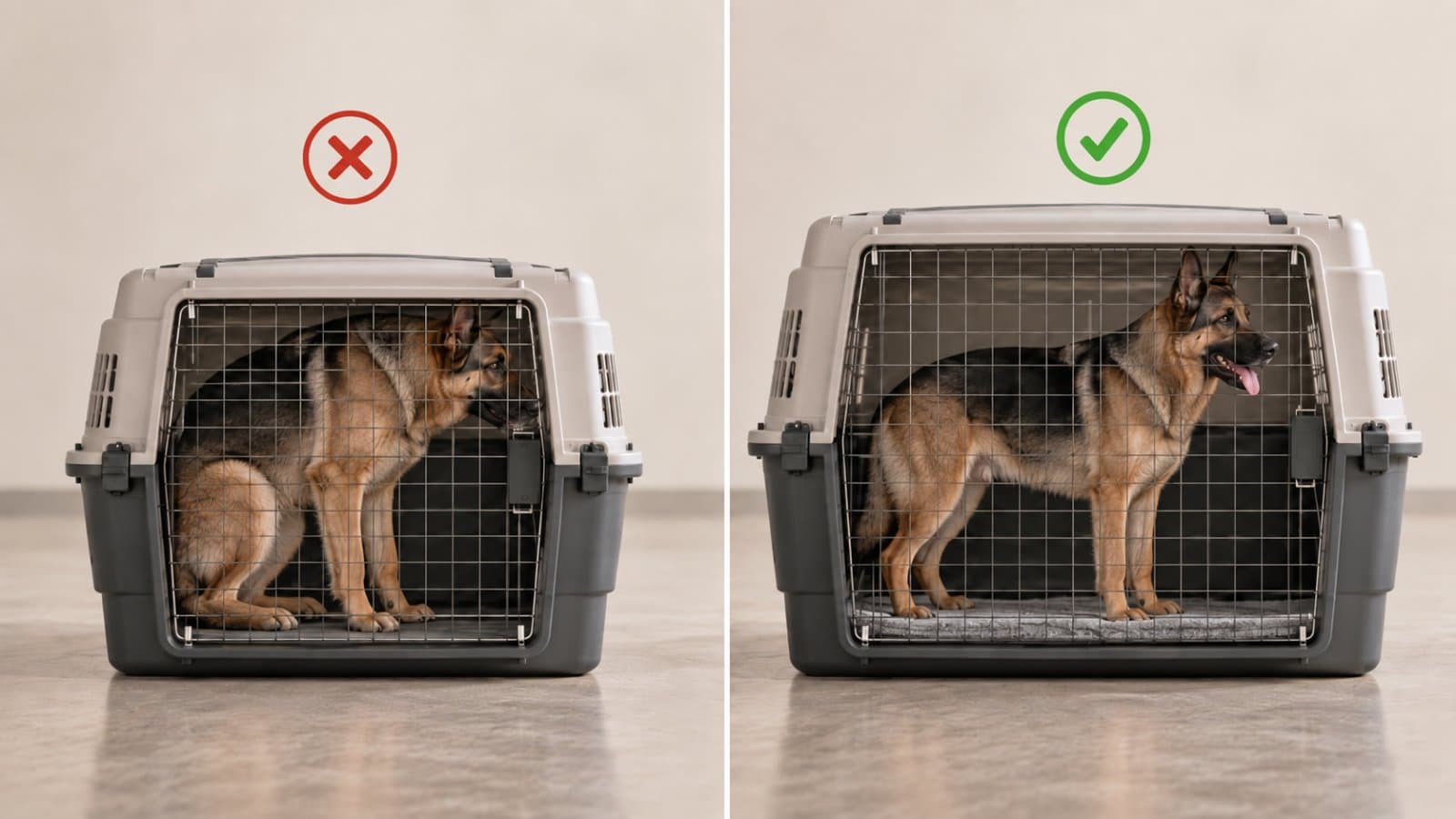
So the crate is chosen from real measurements. In a properly chosen container your pet has to be able to:
- stand in a natural position;
- sit upright;
- turn around comfortably while standing;
- lie down naturally.
This is not "extra comfort". It is one of the basic tests of whether the container meets the requirements at all.
How to measure your dog
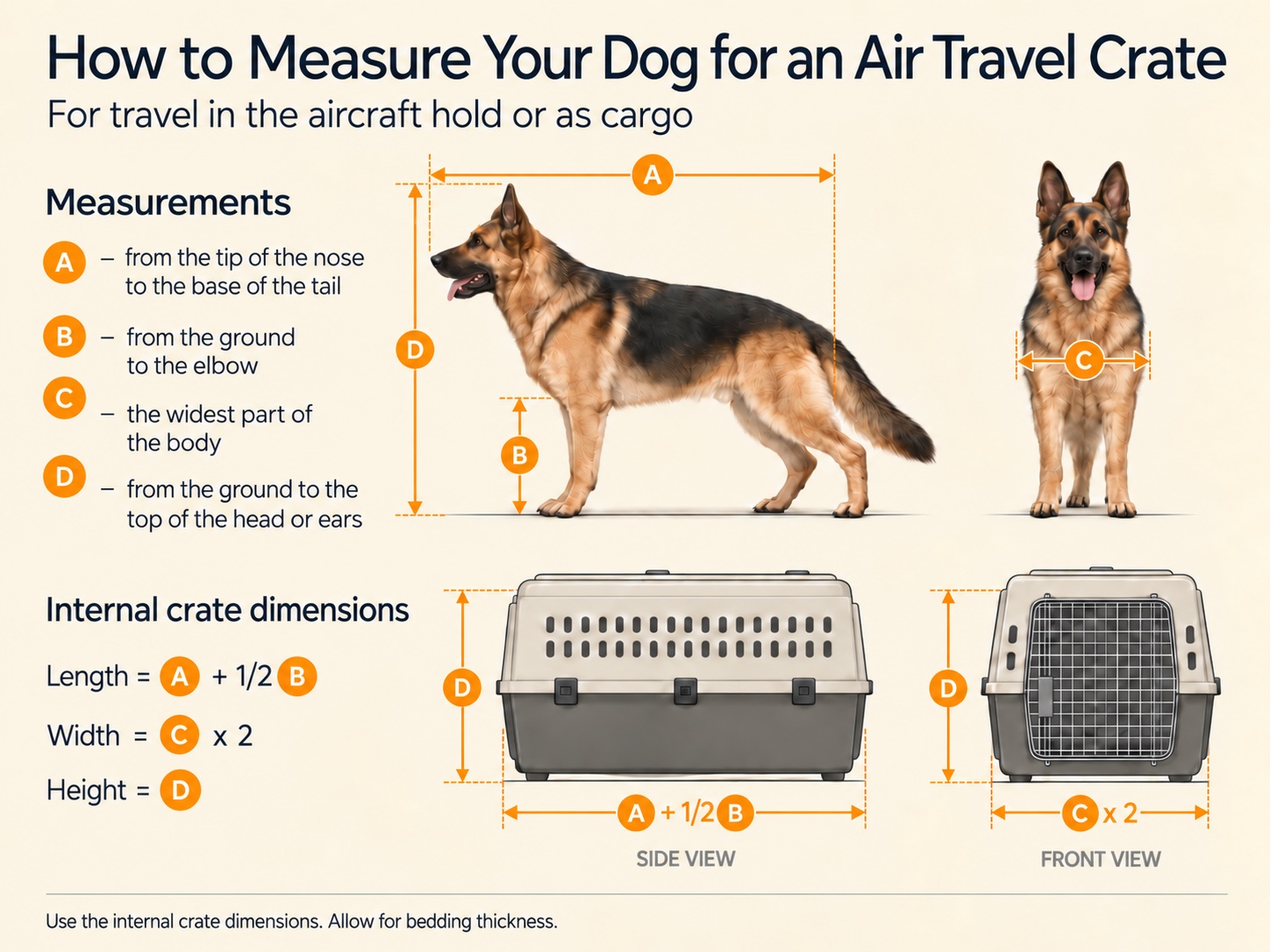
Four measurements: A, B, C and D.
A — length. From the tip of the nose to the base of the tail. The base, not the tip.
B — height of the front leg. From the ground to the elbow.
C — width. Across the shoulders, or the widest part of the body — whichever is greater.
D — full height. The dog stands naturally; measure from the ground to the top of the head or the tips of the ears, whichever is higher. For dogs with upright ears this matters especially: the ears count towards the height.
Working out the minimum size
IATA gives this calculation for the minimum internal dimensions for one animal:
- Length = A + ½ B
- Width = C × 2
- Height = D plus the thickness of the bedding
The word "internal" is the important one. The outside is always larger — walls, the shape of the shell, the door, the handles.
And once you have the figures, look at the animal inside anyway. The formula gives a minimum. The dog should not have their head or ears against the roof, should not have to duck, and should not have to curl up to lie down.
If your dog falls between two sizes
If the measurements put your dog almost exactly on the border between two standard sizes, it is usually wiser to consider the larger one.
But "bigger is better" does not hold here either. A very large crate:
- may not fit the limits of a particular aircraft type;
- may need separate approval;
- affects the price of cargo carriage considerably;
- sometimes physically will not go through the cargo doors of the aircraft you have chosen.
So the job is not to find the biggest container, but the one that suits this animal on this route.
The size is only half of it
A crate can be perfect on measurements and still be turned away at check-in if its construction does not meet the requirements.
For the hold you need a strong, rigid container. IATA allows certain constructions in rigid plastic, metal, fibreglass, wood or plywood; wholly mesh containers are not suitable for dogs and cats. Container requirements (PDF)
The fastenings deserve particular attention
On plastic crates the weak point is often where the top and bottom halves join. It is not enough to see that the container looks intact.
Before the flight, check separately:
- the bolts and nuts;
- the catches;
- the hinges;
- the door lock;
- where the metal door is fixed;
- the plastic around the fixings.
Being carried, loaded and moved puts the crate under stresses it never sees at home.
Ventilation
Air has to reach the animal freely, and the vents must not be blocked by luggage, film, fabric or anything else.
An aviation crate has ridges or spacers on the outside for exactly this reason: so other cargo cannot sit flush against the vents.
The door
The door has to be strong and close securely. The animal must not be able to open it or damage the lock. There should be nothing inside the crate that a dog or a cat could catch on.
Assemble the container fully, close the door and check every fastening by hand — at home, well before the airport.
Wheels
Many large crates have wheels. For carriage they must not let the container roll about. Depending on the design and the carrier's rules, the wheels are either removed or firmly locked.
Another thing to sort out before the trip rather than at the check-in desk.
What goes inside
Absorbent bedding on the floor, safe for the animal. And a water container that can be reached from outside, without letting the animal out.
The exact requirements for water, food and extra equipment are worth checking with the airline: carriers have their own acceptance procedures.
Flat-faced breeds
For dogs with shortened muzzles the requirements are stricter. Pugs, French and English bulldogs, Boston terriers, Pekingese and other brachycephalic breeds.
Current IATA guidance calls for a container 10% larger than the standard calculation for these dogs. On top of that, the airline may impose its own restrictions, or refuse certain flat-faced breeds altogether — particularly in hot weather.
So for a dog like this you first check whether the airline will carry them at all, and only then buy a crate.
Do not buy the crate at the last minute
Even a perfectly chosen container should come home well in advance.
The dog needs time to get to know it and learn to settle inside. Put the crate down at home, leave the door open, put familiar bedding inside, and let the animal go in and rest there of their own accord.
On the day of the flight the crate should not be something your dog sees for the first time at the airport. The more it feels like a familiar space, the easier the journey.
The commonest mistakes
Choosing by weight alone. Weight matters for the conditions of carriage, but it does not decide the length, width and height you need.
Buying "a crate for a labrador". A breed is not a size. Two adult dogs of the same breed can differ noticeably in height and proportions.
Looking only at the outside dimensions. What matters to the animal is the space inside.
Buying a crate that only just fits. If the dog has to duck, or the ears touch the roof, the size is wrong.
Trusting the words "IATA approved". IATA does not certify individual models. A container is judged on whether it actually meets the requirements, and on the rules of the particular airline.
Leaving the purchase to the last few days. If the crate turns out to be wrong, there may be no time left to replace it — or to get the animal used to a new one.
Three things to check before you buy
- Your pet's real measurements. Measure the animal. Do not go by weight, breed or a shop's table.
- The internal dimensions of that particular crate. Compare them with your calculation and make sure the animal can genuinely be inside in a natural position.
- The requirements of that particular airline. IATA sets the international baseline; the carrier can add its own conditions on construction, size, breeds and how the carriage is arranged.
The same crate can be fine for one flight and call for a different solution on another.
A crate is not a formality
The container is the space your animal will spend a large part of the journey in. Its size and construction decide not only their comfort, but the safety of the carriage and whether it will be accepted at the airport at all.
"It more or less fits" does not work here.
First measure the animal. Then work out the minimum internal dimensions. Then check the construction and the airline's requirements. And only then choose a particular crate.