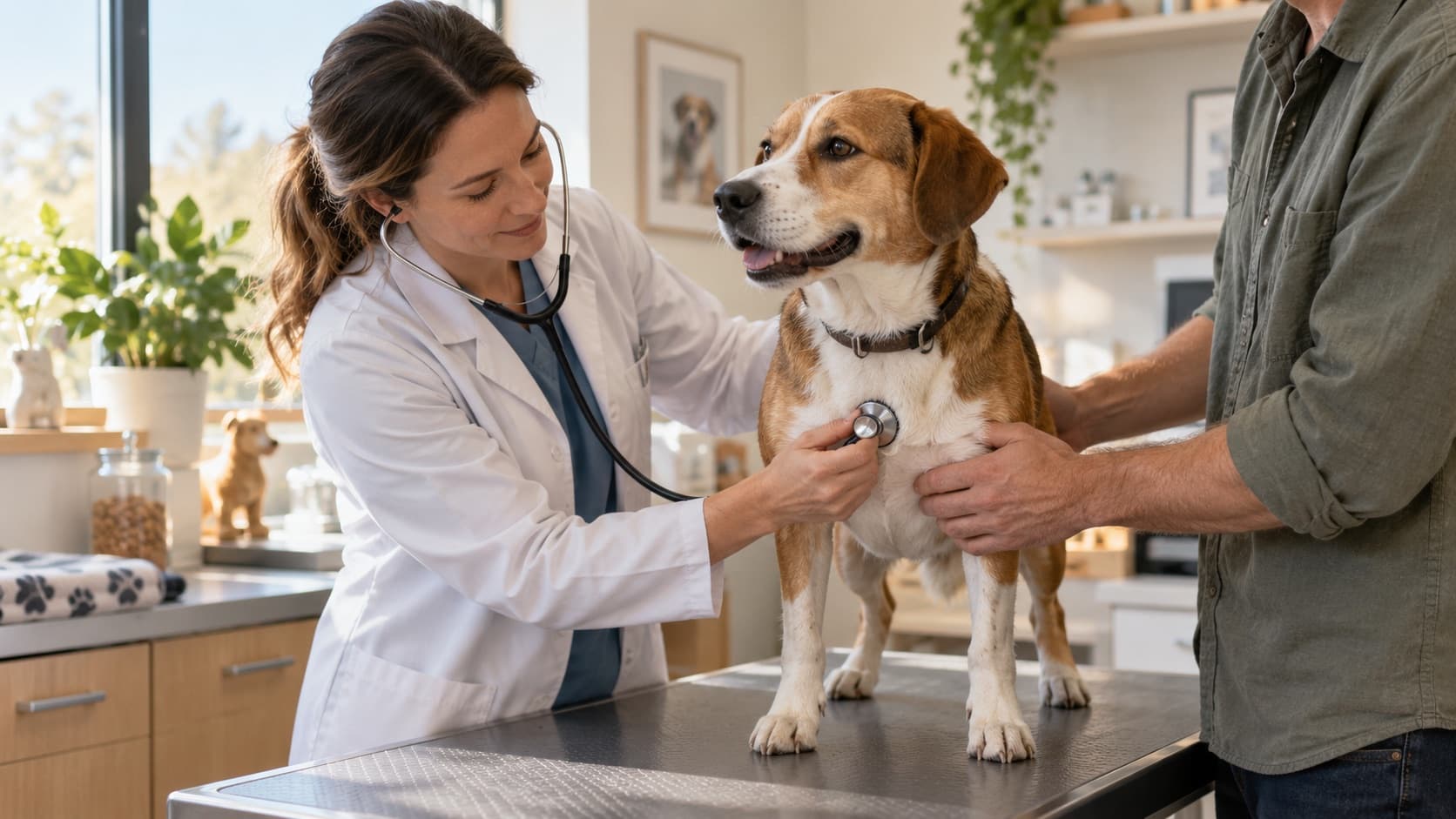
Before a long journey PETIQ asks you to have your pet examined by a vet.
This is not the formal certificate saying "clinically healthy", and it is not a document for crossing a border. The check-up exists to assess your pet's condition before the route begins, and to get a written opinion from a vet: is this animal ready for the journey ahead.
It matters most before a flight, a long drive, a combined route, or a trip with several stages.
Why we ask for it
On a journey everything your pet is used to changes at once: the routine, the food, the rest, the temperature, the level of activity, the surroundings.
So before you set off it is worth making sure there is nothing that could get worse on the way.
A check-up lets you, in advance:
- see the general state your animal is in;
- find anything that argues against travelling;
- understand whether further tests are needed;
- get the vet's recommendations for the trip;
- change the conditions or the route if that turns out to be wiser.
Whether an animal is medically fit to travel is decided by the vet, not by PETIQ.
What the vet should examine
The check-up has to be a full clinical examination. The vet assesses:
- general condition and behaviour;
- weight and body condition;
- body temperature;
- heart rate and rhythm;
- the heart — whether there are murmurs or other findings;
- breathing rate and character;
- the lungs;
- colour and condition of the mucous membranes;
- capillary refill;
- hydration;
- lymph nodes;
- the abdomen;
- eyes and ears;
- the mouth;
- skin and coat;
- the musculoskeletal system, the gait, and any signs of pain.
If something is found during the examination, the vet decides whether further diagnostics are needed.
What has to be written down
We need the written report of the examination, not a verbal opinion.
Your pet's details
- name;
- species;
- breed;
- sex;
- age or date of birth;
- microchip number;
- current weight;
- date of examination.
The findings
Not simply the words "within normal limits", but the actual figures wherever something can be measured:
- temperature;
- heart rate;
- respiratory rate;
- the state of the heart and lungs;
- the mucous membranes;
- hydration;
- what palpating the abdomen found;
- the musculoskeletal system;
- anything abnormal that was found.
If your pet has a chronic condition, a particular health issue or is on ongoing medication, that has to be written down too.
The vet's conclusion — the part that matters most
After the examination the vet has to give a specific medical verdict on whether the animal can travel.
For example: the animal is clinically fit for road transport. Or: the animal is clinically fit for air and road transport.
If there are limits, they belong in the conclusion itself. For example:
- travel is possible with regular stops;
- extra access to water has to be provided;
- a particular feeding routine is needed;
- the prescribed treatment has to continue;
- individual stages of the journey should be kept short;
- a particular condition has to be monitored;
- further examination is needed before a flight.
And if the animal is not fit to travel, the vet has to say that plainly as well, along with what to do: treatment, further diagnostics, a repeat examination, or the date after which the trip can be considered again.
We must not read the results ourselves and decide, instead of the vet, whether an animal can go. That is exactly why the report has to carry a veterinary conclusion.
Are blood tests needed?
Not every healthy animal needs a full diagnostic panel before a trip. For a young animal with no chronic illness, a proper clinical examination is usually the whole of it.
But the vet may recommend:
- a complete blood count;
- biochemistry;
- urinalysis;
- an ECG or echocardiogram;
- an ultrasound scan;
- an X-ray;
- something else.
That matters especially for older animals, animals with chronic conditions, after a recent illness or an operation, and whenever the ordinary examination turns something up.
Do not go and order every test you can think of, just in case. How much diagnostics is needed is the vet's call.
What to tell the vet
Before the examination, tell the vet everything that could matter for the journey:
- chronic conditions;
- operations;
- heart and respiratory disease;
- neurological conditions;
- allergies;
- problems with joints or the spine;
- recent vomiting or diarrhoea;
- coughing or laboured breathing;
- episodes of weakness or collapse;
- illnesses your pet has had recently;
- medication your pet is on now or takes permanently.
Hiding a chronic condition before transport is dangerous first of all for the animal itself.
If the check-up finds something
Something found at a check-up does not always mean the trip is off.
The vet may order further tests or treatment and set the conditions under which travel is still possible. After that we can change how the journey is organised: the length of the stages, the number of stops, the way of travelling, or the route itself.
If the vet judges that transport is contraindicated right now, the trip has to be postponed. There is only one priority here — the animal's safety.
A check-up and a veterinary certificate are different things
They answer different questions.
The check-up answers: does this animal's health allow it to set off safely.
The transport documents confirm that the requirements of the country you are leaving, passing through and arriving in have been met. An international trip can call for vaccinations, tests, a veterinary certificate, an import permit and more.
Even a perfectly prepared set of documents does not replace looking at the animal's actual condition before the road.
What we want to end up with
A good check-up gives three clear answers:
- What state is the animal in right now?
- Is there anything — an illness, an abnormality, a particular feature — that has to be taken into account during the journey?
- Does the vet permit transport, and under what conditions?
We don't need a piece of paper with the word "healthy" on it. We need a professional examination and a conclusion we can plan a safe journey around.