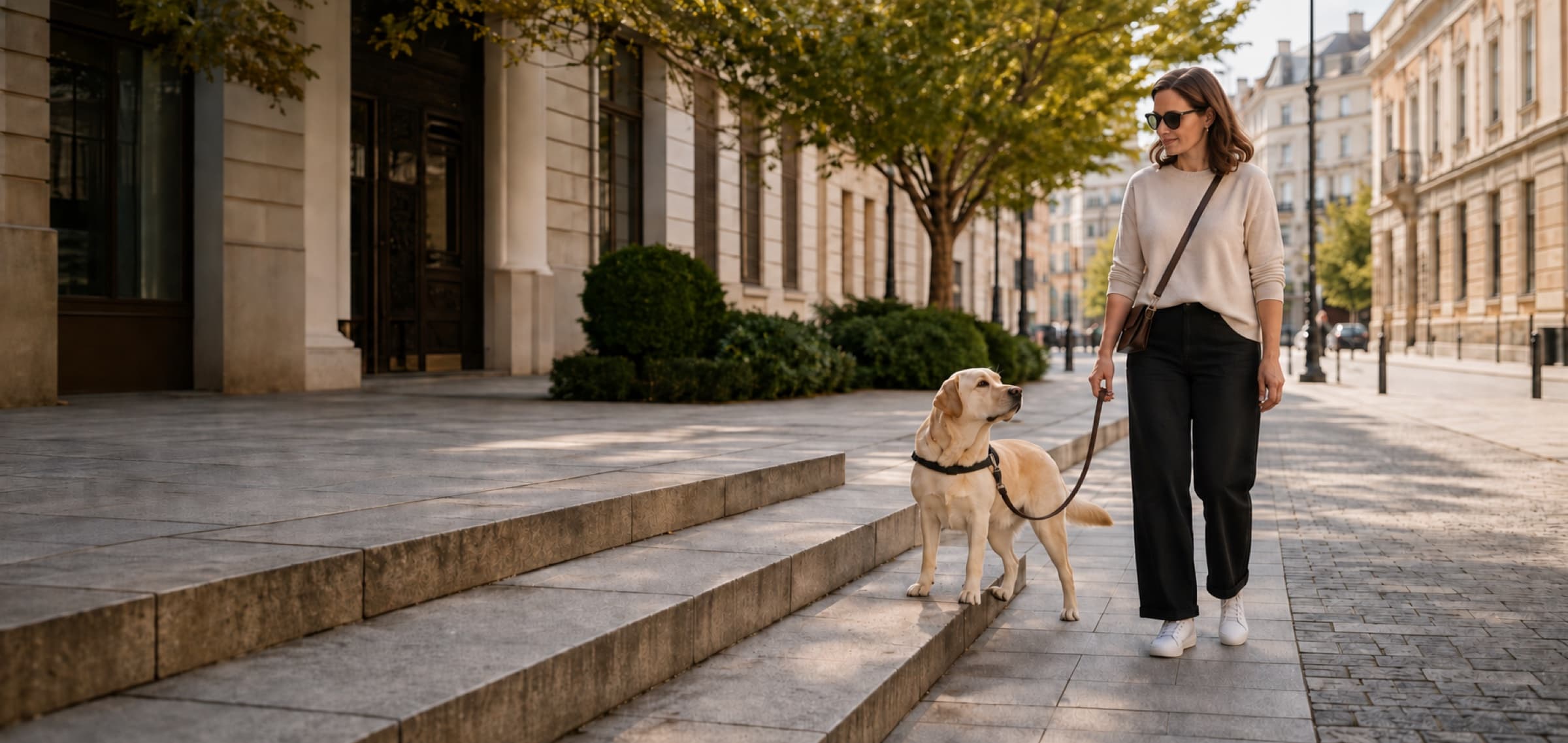
Visual Assistance Service Dog Training Course
Assistance dogs for people with partial sight loss
An individual Service Dog programme for adults and for teenagers from the age of 12 who have a visual impairment. The dog is trained to help its handler move through everyday surroundings more safely: to notice obstacles and changes in surface level, to find objects and people, and to warn of danger.
The programme is for people who can still orient themselves and handle a dog on their own, but who need additional visual support. This is not the classic training of a guide dog for a person who is fully blind.
- At least 120 hours of specialised training
- An individual training plan
- Work in real everyday and public settings
Who the programme is for
The course may suit people with partial sight loss, a restricted field of vision, reduced contrast sensitivity, impaired spatial perception, or marked difficulty moving around at dusk, in unfamiliar buildings and in crowded places.
The programme is open to:
- adults with partial visual impairment;
- teenagers from the age of 12;
- people who need help indoors, outdoors, on transport, at school, in shops and in other public places;
- people who already have a suitable dog;
- families who are still choosing a dog for future training.
The final decision is made after an initial assessment of the person's needs, the dog's behaviour, and the conditions the team will be working in.
How this differs from a guide dog
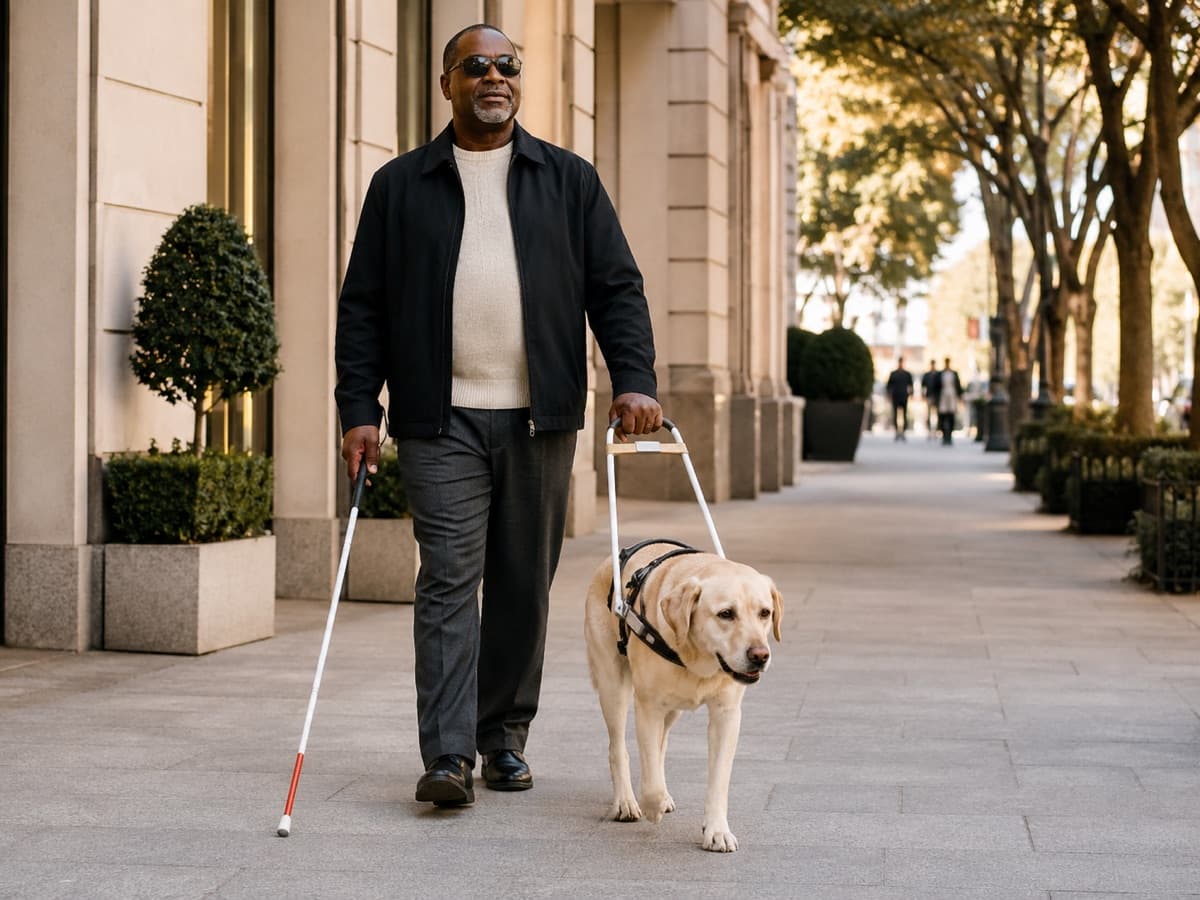
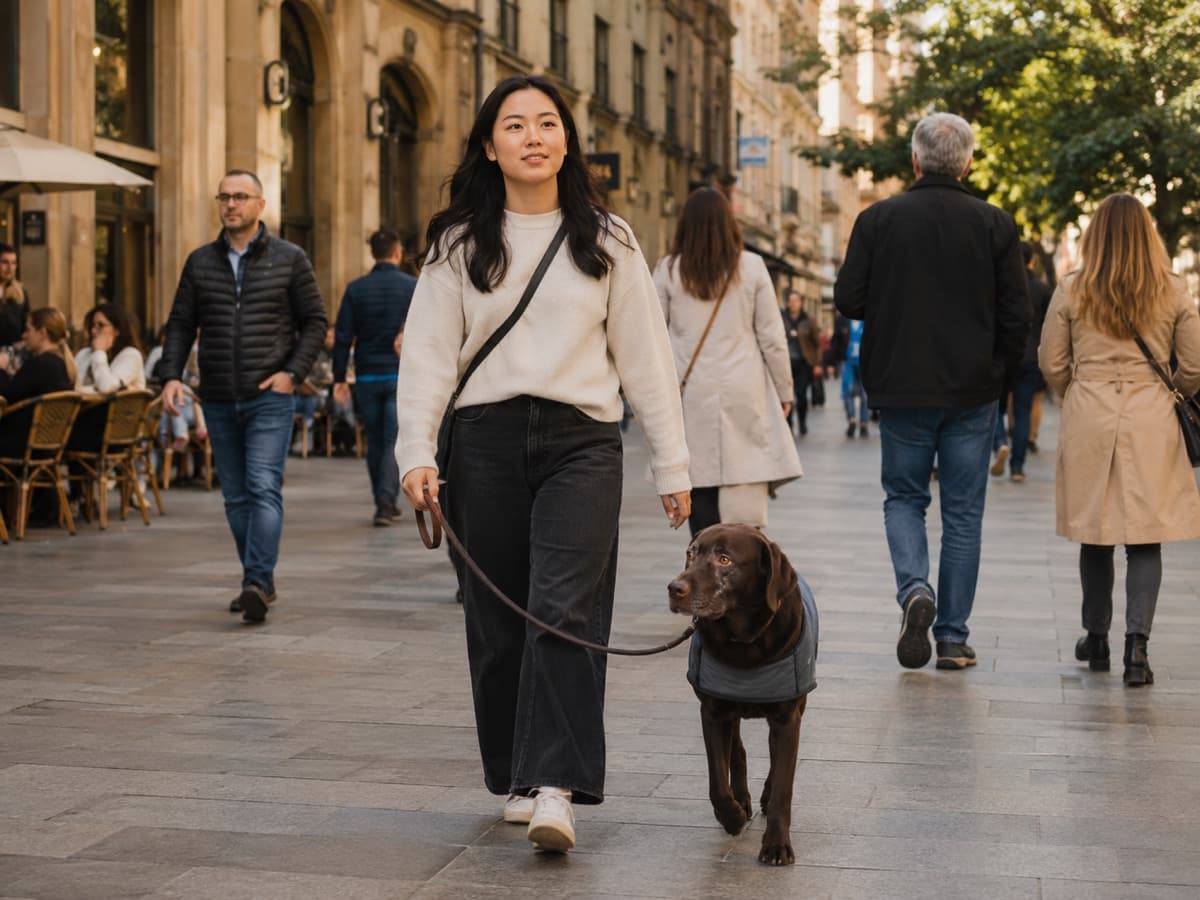
A guide dog takes on the whole task of leading a fully or almost fully blind person along a route.
A Visual Assistance Service Dog works differently. The handler keeps their own orientation and makes the decisions, while the dog performs specific supporting tasks: it indicates obstacles and changes in level, warns of danger, helps find objects, people and exits, and supports safe movement in difficult surroundings.
The programme does not replace orientation and mobility training, and it does not assume that the dog chooses the route or makes decisions on the handler's behalf.
What the dog learns
Safe behaviour in public places
The dog learns to work calmly and predictably beside its handler:
- keeping contact with the handler;
- moving at a controlled pace;
- staying calm on transport, in lifts, in queues and in crowds;
- ignoring people, animals, food and other distractions;
- working at school, in shops, in medical facilities and other public places;
- resting beside the handler without getting in anyone's way.
Indicating obstacles and changes in surface
The dog is trained to notice and indicate:
- kerbs;
- steps up and down;
- platform edges and other changes in level;
- holes, uneven ground and unsafe surfaces;
- narrow passages;
- stationary, moving and overhead obstacles;
- objects that may fall outside the handler's available field of vision.
How the dog indicates is chosen individually and has to be clear to that particular person.
Safe navigation
The programme covers work:
- on familiar and unfamiliar routes;
- indoors and outdoors;
- at dusk and in poor light;
- in crowds and among moving people;
- in doorways, corridors and narrow passages;
- allowing for the combined width of the working pair;
- on everyday routes: home, school, transport, shops and wherever else is needed.
The dog learns to choose a safe line of movement, go around obstacles and hold its working position beside the handler.
Active hazard warning
If moving on would create a real danger, the dog must not simply follow the command: it has to actively warn the handler and, where necessary, refuse to move forward. This may apply to:
- a sudden obstacle;
- a moving object;
- a dangerous drop in level;
- a blocked passage;
- a situation where following the usual command becomes unsafe.
This warning is not an audible alert. The dog uses a physical or behavioural signal trained in advance.
Finding people, places and objects
Depending on individual needs, the dog can be trained to find and indicate:
- parents, family members and other people agreed in advance;
- doors and exits;
- a free seat or space;
- the till;
- stairs or a lift;
- a service desk;
- rooms at school;
- the toilet;
- a stop or the entrance to a vehicle;
- personal belongings and everyday items.
Help in everyday life
The programme may include:
- finding a dropped item;
- picking up and handing over personal belongings;
- finding a phone, a bag or another named object;
- help getting oriented in an unfamiliar building;
- leading the handler to a particular person or object;
- holding a safe position beside the handler in everyday situations.
The exact set of tasks is decided after assessing the needs of the future beneficiary.
How the training goes
- 01
Initial consultation
We talk through the person's sight, their daily life, their main routes, the situations they find difficult, and the tasks the dog is needed for.
- 02
Assessing the dog
Temperament, resilience, health, trainability, attitude to people and animals, the ability to work in public places and to recover after a demanding session.
- 03
An individual plan
Based on the assessment we set out the functional tasks, the working signals, and the conditions the dog will have to work in.
- 04
Foundation and specialised training
First obedience, contact with the handler and public behaviour are made solid. Only then does training on visual assistance tasks begin.
- 05
Work in real surroundings
Skills are practised not only on a training ground but on the routes the person actually uses every day.
- 06
Preparing the working team
The handler learns to give commands correctly, to read the dog's signals, to maintain the skills and to work safely together in different situations.
- 07
Final assessment
Public behaviour, control, the individual tasks and the readiness of the team to work together are all checked.
The programme for minors
Teenagers are accepted from the age of 12. The child or teenager is the Primary Beneficiary.
An adult parent or legal guardian must take part as the Supporting Handler. They train alongside the teenager, help with handling the dog, are responsible for its care and safety, and accompany the working pair where that is needed.
The certificate and the accompanying documents name both the primary beneficiary and the adult supporting handler.
When the programme may not be right
Taking part may be impossible, or may require preparation first, if:
- the dog shows aggression or marked anxiety;
- the dog cannot work safely in public places;
- the dog has serious health problems;
- the person cannot handle the dog, alone or with a supporting handler;
- the family is not ready to train regularly and keep the skills up;
- the dog is expected to navigate entirely on its own, as a classic guide dog does;
- the main need is not about sight but about sound alerts, a medical condition, balance or physical support.
Hearing assistance, medical alerting and other tasks require a separate training programme.
Can an existing dog be trained?
Yes, if the dog suits this work in health, temperament and behaviour.
An assessment before the course is compulsory. Good obedience at home does not by itself mean a dog is ready to work as a Service Dog. It has to stay calm in difficult surroundings, recover quickly after a demanding session, show no aggression, and carry out tasks confidently beside its handler.
If there is no dog yet, we can help set out the requirements for a future dog and assess a candidate before training begins.
How long the training takes
The programme includes at least 120 hours of training: foundation skills, public behaviour, specialised tasks, and the team working in real conditions.
It usually takes four to six months. The time depends on the dog's age and previous training, the number of tasks needed, how regularly you practise, and how demanding the conditions are that the dog will work in.
Some teams need longer. The certificate is issued only after the programme is completed and the final assessment is passed.
What you receive at the end
After successfully completing the programme, the working team receives:
- a Certificate of Completion;
- an annex to the certificate listing the modules and functional skills covered;
- an individual certificate number;
- a Service Dog ID card;
- an online profile for the dog with a QR code for checking its details;
- recommendations for maintaining and developing the skills further.
The certificate confirms that the training programme was completed and that the tasks listed in the annex are performed. It is not a government document and does not by itself guarantee access to any country, airline or organisation: the rules have to be checked separately for each trip and jurisdiction.
Other programmes
The first step is assessing the future working team
To find out whether the programme suits you, we need to look at the needs of the future beneficiary and at what the dog is capable of. At the initial consultation we discuss:
- the situations where help is needed;
- the tasks the dog should perform;
- whether your dog suits the programme;
- what format the training will take and how long it will need;
- what documents and results you receive at the end.